
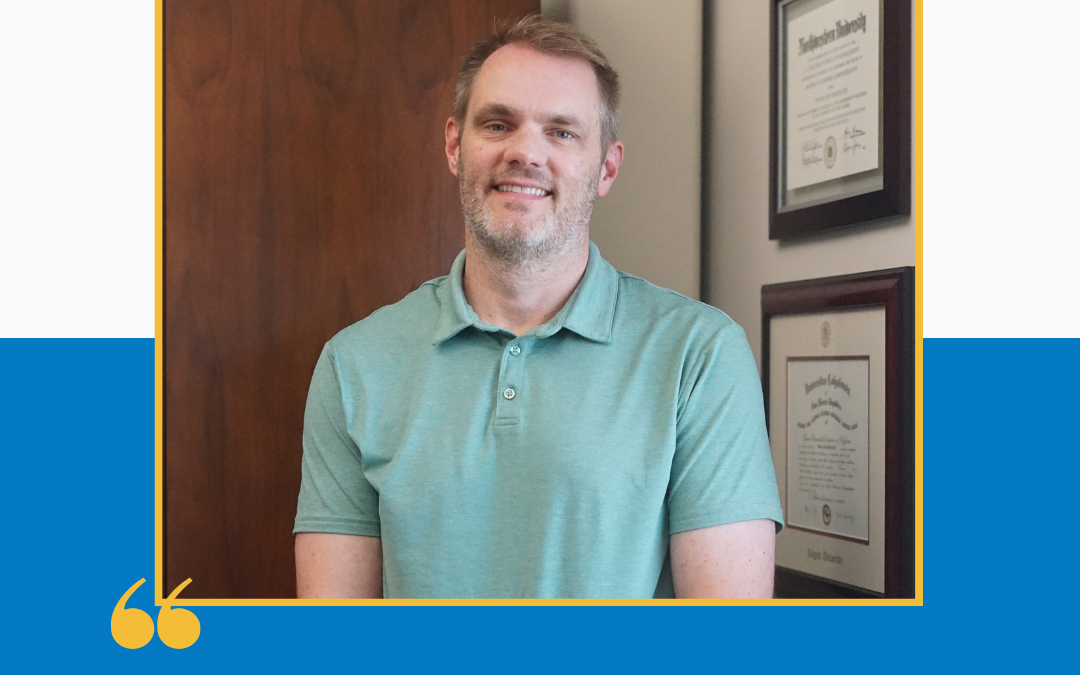
Steve Windfeldt, Co-CEO of Preferred Credit Inc. once thought he was going to be a teacher. Now, he nurtures his passion for coaching by leading forum discussions with the Anderson Center. Steve’s leadership philosophy was shaped by his father, who modeled passion for his job and dedicated himself to promoting and developing employees. After graduating from business school at Kellogg, Steve sought out positions where he could learn, lead with impact, and create value. As co-CEO at PCI, he is focused on building a strong culture where employees truly buy into the mission.
Q: What do you think makes a good leader?
SW: “I have a major philosophy that management is given to you; leadership is earned. You can make somebody another person’s manager, but they don’t become their leader until that person accepts them as a leader…Leading and dictating are two different things, too. Right? Dictating is telling everybody what to do. Leading is truly knowing how to give people a vision, be in a position so that you understand whatever you’re trying to accomplish, and help get people there. And I think you can lead from the bottom. I think you can lead from the top. I don’t think it takes a specific type of personality. Some people can be very quiet leaders. Some people can be very vocal leaders. But I think what they all have in common is humility, empathy, and the ability to have the confidence in themselves to know when to step forward and when to step back.”
Q: Not everyone in an organization feels like they have the power to lead. In practice, what do you think it looks like to lead from the bottom?
SW: “You lead from the bottom by showing up. Not just physically showing up; showing up with your full mind, body, and spirit so that you are there and others–at minimum–watch you, but they also get your energy. They get that you’re there for more than being told what to do…Before you know it, you’re five years into your career, and you have a network of people that, formally or informally, you’re leading because they see what you’ve done and they want to do it. You’ve given them a path. You’ve given them a vision.”
Q: If you could give one piece of advice to your 20-year-old self, what would it be?
SW: “Just learn. Just keep learning…That was actually why I took the job under Rick. I was paid probably quite a bit less than I would have gotten on Wall Street or some other jobs that I had opportunities in. But what I saw was somebody I could learn from, and so early in my career I always sought positions and people that I could learn from, because I knew the money would eventually catch up. What was invaluable was that I could either be 1 of 25 people or 1 of 1.”
Q: Do you have any leadership ‘hot takes’ or surprising opinions about leadership, culture, or people development that might surprise others?
SW: “I don’t believe that there’s anything new out there. But something maybe a little less obvious to people is this idea, and there’s a good book on it called Give and Take by Adam Grant. I feel like if you look at what’s the biggest commonality in a cliché version of who the ‘best leaders’ are, they generally give without an expectation to receive…The true givers, I think, are the ones that make the best leaders because they truly just don’t care what comes back to them.”
Responses edited for length and clarity